Every few weeks someone leans on the counter at our Otley taproom and says, "How do they actually get the alcohol out?" Usually while holding a can and squinting at it like it's a magic trick.
Fair question. I ferment things for a living. My kitchen permanently smells like a vinegar factory had a row with an orchard. But even I don't brew my own alcohol-free beer, and by the end of this you'll understand why.
Right. Pull up a chair. Here's how the professionals do it, and what you can realistically try at home.
The short answer
Non-alcoholic craft beer is made in one of three ways. Brewers either stop the yeast making much alcohol in the first place (limited fermentation), use special yeasts that can't turn most of the sugar into alcohol, or brew a normal beer and then take the alcohol out with specialist kit (dealcoholisation). Lots of the best craft brewers mix and match. In the UK, it can be called alcohol-free if it's 0.5% ABV or under.
Method 1: limited fermentation (don't let the yeast get going)
Yeast eats sugar and makes alcohol and fizz. That's the deal. So the simplest trick is to give the yeast less to eat, or stop it early.
Brewers do this by mashing the grain hotter than usual. That makes more chunky sugars the yeast can't digest, so you keep body and sweetness without much alcohol. Some also cool the beer right down and take the yeast out before it finishes the job.
The catch? Stop too early and you get something sweet and "worty", which is brewer speak for tasting like a damp Weetabix. Most of the thin, sugary alcohol-free lagers you gave up on in 2014 were probably victims of this. It's the Ross and Rachel of brewing methods. Lots of potential, very easy to get wrong.
Method 2: special yeasts (the lazy lodger approach)
This is where it gets clever. There are yeast strains that simply can't eat maltose, which is the main sugar in beer wort. Brewers call them maltose-negative yeasts.
They'll happily munch the small amount of simple sugar, make a bit of flavour and fizz, then put their feet up. The maltose stays put, so the alcohol stays low. Imagine a lodger who'll eat the biscuits but won't touch the main fridge. We've all lived with one.
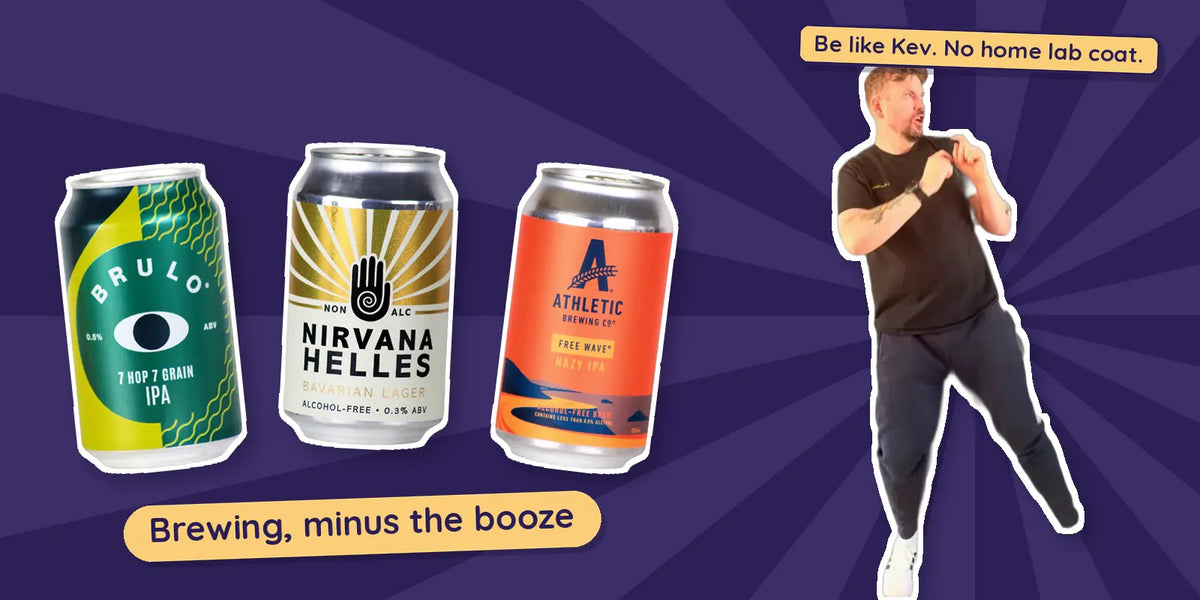
A lot of modern craft brewers lean on this. Brulo, for example, talk about "clever yeast and modern brewing" in their beers, and their Brulo 7 Hop 7 Grain IPA packs seven hops and seven grains into 56 calories a can. Jump Ship in Edinburgh brew everything naturally under 0.5%, and their Jump Ship Stokers stout manages coffee, dark chocolate and zero sugar.
Method 3: dealcoholisation (brew it normal, take it out after)
Here, the brewery makes a full-strength beer and then removes the alcohol. This needs serious kit, not a saucepan and optimism.
The two main ways are vacuum distillation and membrane filtration. Vacuum distillation lowers the pressure so alcohol comes off at a much lower temperature, which stops the beer tasting cooked. Membrane systems (like reverse osmosis) filter the beer through super-fine membranes to separate the alcohol out. Then brewers often add back aroma, or dry hop again, because hop aroma tends to leave with the alcohol like a mate who only came for the free buffet.
It's the same family of methods used for alcohol-free wine, which I cover in what's actually in alcohol-free wine. And if you want the bigger picture of where all this tech is heading, have a read of the future of alcohol-free drinks.
Why some breweries are better at it than others
Taking alcohol out isn't the hard bit. Keeping the beer tasting like beer is. Alcohol gives body, warmth and carries aroma, so when it goes, something has to fill the gap.
Good brewers fill it with oats and speciality malts for body, loads of late hops for aroma, and smart recipe design. Mash Gang put oats and a sneaky touch of chilli in Mash Gang Chug for that fluffy body and warmth. Athletic Brewing in the US use their own method, and Athletic Free Wave is juicy, velvety and 70 calories.
And Nirvana in East London are the UK's only dedicated alcohol-free brewery with its own brewhouse. Their Nirvana Bavarian Helles sits at 0.3% and tastes like the first pint on a sunny day. If you want to know which breweries I'd trust with your money, I've written up the alcohol-free craft beer brands worth backing.
Can you make alcohol-free beer at home?
You can make low-alcohol beer at home. Truly alcohol-free is much harder. Homebrewers mostly use Methods 1 and 2: a hot mash for a less fermentable wort, plenty of oats for body, and a low-alcohol or maltose-negative yeast strain from a homebrew supplier.
But here's the honest bit. Without a lab test, you don't actually know your ABV. Your "0.5%" might be 1.2%. So drink it yourself, don't hand it to anyone who needs zero, and don't call it alcohol-free.
Low-alcohol beer also has more sugar left in it and less alcohol protecting it. That means it spoils faster and, in bottles, can keep fermenting and build up dangerous pressure. Keep it cold, drink it fresh, and be very careful with bottling. Exploding bottles are not a fun way to redecorate.
What you should not do is try to boil, cook or distil the alcohol off at home. It wrecks the flavour, and distilling without an HMRC licence is illegal in the UK. You're a homebrewer, not a Breaking Bad subplot.
Or, you know, let someone else do it
This is where I wave my hands at the shelves. People who've spent years and a small fortune on kit have already done the hard bit, and they've done it brilliantly.
You can mix any six or more drinks in our build-a-box and get 5% off, 10% off for 12+, or 15% off for 24+. Delivery is free on UK mainland orders over £85, and £4.95 under. Or have a browse of the whole alcohol-free beer range, which is considerably less effort than cleaning a fermenter at midnight.
It's a lot like the people who swapped their hangovers for five-hour runs. Admirable. Exhausting. You can just have a nice can on the sofa instead.
The serious bit
In the UK, drinks up to 0.5% ABV count as alcohol-free, but that isn't 0.0%, so check the label if you need zero. If you're pregnant or on medication, check with your GP first. Homebrewed beer can't be guaranteed below any ABV without lab testing, so don't give it to anyone who needs to avoid alcohol completely.
If you're worried about your drinking, Drinkaware and the NHS have free, confidential support.
Kombucha Kev, Functional Drinks Club